


Jan EckertCEO JLL Switzerland & Chairman Capital Markets DACH
You began your career at Arthur Andersen, later helped build the real estate practice in Switzerland as a partner at Andersen, and then continued your career at Ernst & Young and Sal. Oppenheim, before you founded Jones Lang LaSalle AG (JLL) in Switzerland in 2011. Looking back on that path: How did you experience these different career steps, and what motivated you to establish JLL in the Swiss market?
That wasn’t planned. I never deliberately looked for a new job. Things developed, and always together with my team. After my studies, I joined Arthur Andersen, an audit firm, in 1991. The real estate crisis was just beginning in Switzerland at the time, and attractive entry-level opportunities were rare. I actually wanted to join an advertising agency, but they weren’t hiring anymore. I also felt that after my studies I wasn’t yet adequately prepared for working life. I had studied accounting and business management, but I lacked practical experience. Auditing was therefore an ideal start: It teaches you the trade from the ground up.
At Andersen, as a young partner, I was able to build the Real Estate Advisory practice. Our focus wasn’t on traditional real estate advisory but on the securitization of Swiss banks’ mortgages. That first mandate gave us expertise, experience and a result we could point to and offer to other clients. The second mandate followed, and eventually a business line. It was a very organic process. Then came the collapse of Andersen in the wake of the Enron scandal, which we had no influence over. Afterward, we moved as an entire team to Ernst & Young, which in the end was like a reverse takeover, and we took all our mandates with us.
Ernst & Young was a different world. After Andersen’s collapse, new regulations for auditors came into force, and the conflict between audit and non-audit clients intensified. We worked in corporate finance, handling corporate and real estate transactions as well as securitizations, but we could no longer serve some clients. Our business was very profitable but became so restricted that we could no longer thrive. So we asked ourselves whether this environment was still the right one for us. Together with about 30 colleagues, we decided to leave the firm. The entire investment banking and corporate finance team, including real estate, moved to Sal. Oppenheim and built an investment bank there with a focus on real estate.
In 2010, at the end of the financial crisis, Sal. Oppenheim collapsed as well. At the time, Oppenheim was Europe’s largest private bank. After more than 15 years, it was also clear to us that the banking environment was interesting but had its limits: An investment bank like Sal. Oppenheim could hardly work with other banks. By chance, I then met a former Andersen partner. He told me JLL could imagine entering the Swiss market if a strong team could be found. First conversations followed, and from them came a buyout from Deutsche Bank, which had taken over Sal. Oppenheim. In 2011, we moved to JLL together, and we’ve been responsible for the business in Switzerland ever since.
The common thread has always been the team. We never made decisions alone, only as a group, with a shared mindset: This isn’t how we want to do it. We see more opportunities here, and we’ll go after them. Twice our employer changed fundamentally, and once we ourselves decided to leave the firm. In those phases, it was important to me to stay close to our clients and keep the business going actively.
As a partner, you already helped build a new business area in the real estate sector. How do you establish a new business unit within an existing consulting firm, and what requirements must be met to do so?
In principle, there are two types of companies in consulting and services. The first type constantly has to look for new topics. They pick up new developments, work through them and offer them as a service. Otherwise, they eventually specialize in a single topic for good. In recent years, large consulting firms have built their own units that support organizations in implementing artificial intelligence (AI). This attentiveness to what clients need and what’s happening in the world is essential for anyone who wants to enter consulting. The other type is a company that sticks with the same product for generations. At heart, I’ve always been a consultant. I’m interested in what clients need, what new needs are emerging and how the way of doing business is changing. If you don’t stay on top of that, you lose touch with your clients. Even auditors have to regularly question their audit approaches to understand how the client’s business works.
A company has to give young employees that opportunity. Partners and experienced advisors can’t do everything. That’s why it’s important to keep opening up new fields and give employees the chance to grow in them. At 26 or 28, you can’t simply decide: “I’m going to start a new business unit now.” A partner has to provide money, resources, time and training. It takes more than just willpower.
In my day, the market was interesting: It was the real estate crisis, and afterward the first large mortgages came along, that is, mortgage securitization. We didn’t start with real estate advisory but with the securitization of Swiss banks’ mortgages. At Andersen, I managed a mandate for a cantonal bank, in which we securitized what was then the largest non-performing portfolio. That gave us expertise, experience and a reference case we could offer to other clients. From an idea, from an advisory approach, eventually comes the first mandate, the second mandate and then a business area of its own. At the start, you hire two or three employees, and over time the team grows. It’s an organic process, and luck certainly played a part. I also didn’t do everything alone. I always had very good employees, and I gave them room to work. You can’t build something or change something in a company on your own. It takes conversations, persuasion, like-minded people and initiatives. A senior partner at Andersen Consulting taught me something important on this:
If you’re in an organization where you can change what you want to change, you’re in the right place. If not, you’re in the wrong place.
Your core team has apparently stayed loyal to you across several career stages. What did you do as a leader to build this cohesion and to keep people committed to you over the long term, even when the professional environment changes?
That’s hard to judge. You’d really have to ask my colleagues. But I believe I’ve always delegated responsibility and shared knowledge so that others can benefit from my experience. To me, that’s part of training and development. My philosophy is:
My goal isn’t to stake out a territory of my own but to give people access. Our clients don’t belong to individuals but to the whole team. Collaboration is deliberately fluid.
That way, people see that they have prospects, can grow and that it can be financially rewarding, too. When we work together and succeed, we achieve more than one person alone.
At Andersen, I learned this: If you hire employees, you should look for people who are better than you, not just as good. With my resume back then, I probably wouldn’t be hired today. What mattered to me, though, was never the perfect resume but curiosity and commitment. It’s important to attract talent who can take over the business one day so that we can turn to new tasks. I’ve always given employees room to work and collaborated as partners with my colleagues. That’s worked well to this day. You can’t do something like this alone.
Big decisions, such as the moves from one firm to the next, were never made alone, either. They were made together as a group, with the people you work closely with. There are always nuances, and it doesn’t always run in a straight line. There are decision points where you have to check whether you did it right, and we certainly didn’t always decide correctly. But it led to a team in which some core people have worked together for a very long time.
Especially in crises like those we went through at Andersen and Sal. Oppenheim, it became clear how important it is to remain able to act as a team. We consistently stayed with our clients, continued our mandates and kept the team together. In such phases, those involved pull together because they have a task and see a way forward.
In a conversation with the founders of the Swiss Finance & Property Group, you brought up real estate markets such as Italy, Spain and Portugal, among others. When you evaluate a real estate investment: Which factors are decisive for you in recognizing an attractive investment opportunity?
The first question is: What do I want from my investment? It’s not always the same question at all. I can invest in Spanish real estate as a pension fund, that is, as an institutional investor. I can invest as a private individual, or as an opportunistic investor who buys for the short term, sells again quickly and withdraws capital. There are different reasons to invest in real estate, and they don’t have to be the same. As a pension fund, I want to be invested for a long time, but then I have currency risk against the euro. Does it make sense to buy something in Madrid if the return after currency hedging is lower than in Zurich? For a family whose entire wealth is only in Switzerland, it can make perfect sense to accept currency risk for risk diversification and, for example, buy real estate in the U.S.
Investment horizons differ as well. There are evergreen funds that have 10 years and special-situation funds that run only three to five years. They go into a market that’s currently difficult, buy now and sell in three years in the hope that things go better. I can also develop a property and sell it in three years or buy it for the next generation of my family. Each one is a completely different motivation, and you have to take it into account when you invest.
Our greatest risk is our comfort zone: Switzerland is small, safe, established and wealthy. International markets are different. Anyone who wants to succeed there can’t treat Swiss conditions as the benchmark.
Beyond that, currency, taxes and political stability are central. Am I entering a market where rental law will stay the same for another 20 years, or will it change? The early elections in Spain are closely tied to housing policy. For investors, legal certainty in rental law is central. This has nothing to do with the quality of individual properties or of cities such as Madrid, Barcelona or Valencia, but with political uncertainty that, from a Swiss perspective, can’t be influenced. This has to be taken into account before looking at the micro level of a single building.
The same applies to natural hazards: Floods like the recent ones in Valencia show how strongly natural hazards can influence an investment decision. Anyone who has just bought a house may have to bear high repair costs. It’s similar with earthquakes: In Switzerland, the risk isn’t very present in everyday life; in Istanbul or Ankara, it’s a central issue.
Market cycles also shape the view. The Spanish real estate crisis was one of the longest in Europe: From 2006 to 2012, there was hardly any transaction activity. Anyone who entered in 2014 experienced only rising markets for about six years, until COVID, and could no longer imagine crises. Someone who starts in a crisis develops differently.
We need to focus on selected markets. Nobody can understand the whole world, and the aspiration to be broadly positioned globally is unrealistic.
Only after that comes the micro level: What’s the location, how’s the building oriented, and what’s the quality of the micro location? How are the leases structured, what’s the tenant mix, and how does the property fit into its surroundings? This homework applies in Zurich just as much as anywhere else. But first I have to understand the framework conditions and clarify what I want to achieve with the investment. That’s also important in the discussion with our investors: Do they want to stay invested in Spain for the long term, or is it only temporary? Then you can build strategies. That’s craftsmanship: lots of research, talking with markets and market participants, and trying to understand the connections.
In the U.S., for example, I look at Houston or Miami, and in Europe at London or Madrid. The selection can also be subjective: You already have an office or infrastructure there, know people on the ground, or the family already owns a property. What matters is access to the market and an understanding of language, culture and the political environment. For that, you need local partners. Friends of mine, for example, own houses in South America. With markets like that, I know the culture and legal framework too little. As long as I lack that understanding, I focus on markets that are more accessible to me and that offer equally attractive opportunities. No advisor knows all the markets in the world equally well. What matters is understanding the macro level. Without that understanding, an investment remains pure speculation.
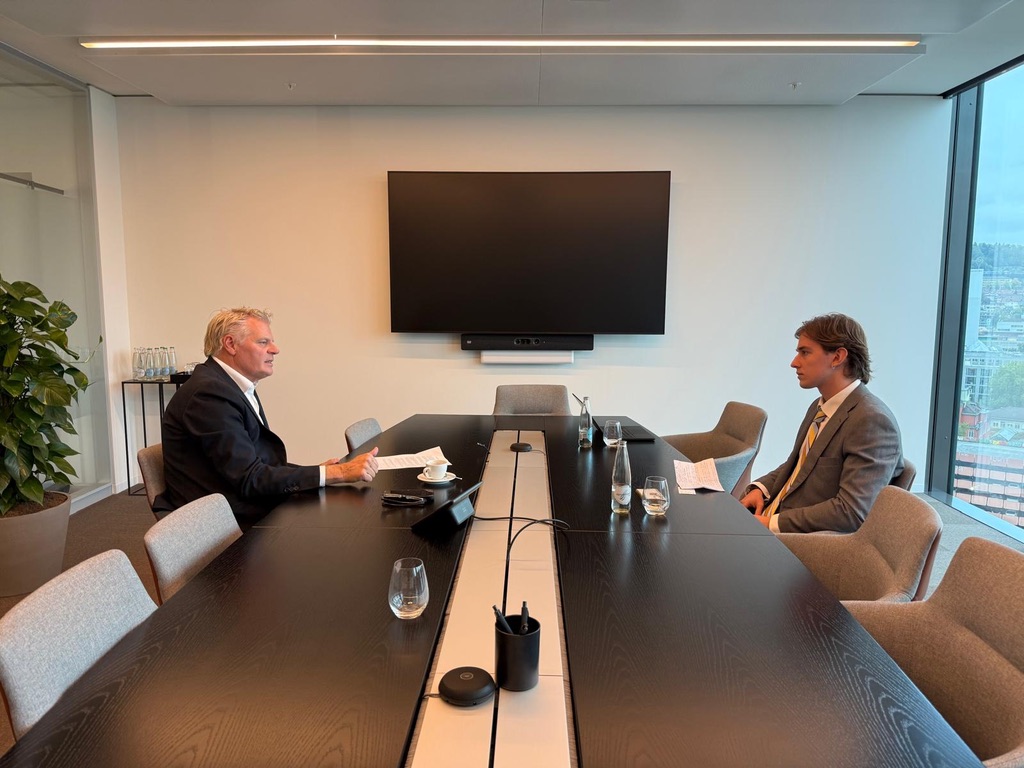
What still fascinates you personally about the real estate industry, and how has your view of the market changed since the beginning of your career?
What I like: It’s relatively easy to enter the market, and the spectrum ranges from down-to-earth deals to highly complex structures like securitizations, derivatives and indirect transactions. You experience the whole spectrum of life. Recently, I toured an apartment building with very affordable apartments. Visits like that remain important because they keep my eyes open to other realities of life. For many households, utility costs are a real burden: Even an extra 200 Swiss francs for heating is noticeable in the monthly budget. This reality keeps me grounded and reminds me why we do what we do and for whom.
We’re not in some lofty world of derivatives banking where everyone lives in their own bubble. The industry is highly complex, legally, technically, structurally and from a regulatory standpoint, and at the same time it’s a down-to-earth business. I’ve always liked that. Real estate is tangible: At the end of the day, you can touch it. That’s why it’s still an exciting industry for me after more than 40 years.
My view of the industry has changed over the years. I didn’t enter the real estate business because I had planned it. Through the securitization of mortgages and the real estate crisis, I grew into the market, and over time an advisory approach became a business area of its own and a profession. For real estate, you need a feel for it: You have to want to work in this market, love it and commit to it. It’s like architecture: a profession, not just a job. My experience with market cycles has also shaped my view. Anyone who starts in a crisis develops differently from someone who has experienced only upswings. You learn that nothing can be taken for granted.
Education teaches how something works. Exchange, on the other hand, often teaches you what doesn’t work. That’s why discussion is so important.
Our external presence has also changed. In the past, we produced slim brochures of a few pages that covered the fundamentals and the market situation for real estate. Clients ordered them from us and passed them on. Today we produce podcasts. The goal has stayed the same, though: communication, knowledge sharing and discussion.
Which skills do you think will be especially important over the next 10 to 20 years for young people pursuing a career in finance, consulting or real estate?
In the past, it was largely clear how the path would unfold: You became a banker, auditor, lawyer or architect. Today it’s much more open, and that’s precisely why one quality matters more than ever: curiosity. Looking back, the people around me who became both successful and satisfied were always curious. You have to hold on to that curiosity for good. You shouldn’t think that after a university degree, even from a renowned university or with a semester abroad, you already know how the world works. What matters is staying open and diving deep into topics that truly interest and excite you. That inner fire is still central for me. That’s exactly what I ask almost everyone who joins us about.
Real estate takes passion: a feel for the market, joy in the work and genuine commitment. As in architecture, it’s about a profession, not a job.
That includes commitment. Especially in the high-performance years after graduation, it pays to give your all. It’s not an 8-to-5 job. People who enjoy the topics feel the time demands less and learn significantly more, and faster, than if they take it easy. In the first 10 years of a career, learning comes first for me. Financial recognition usually follows later, and the reward is then generally correspondingly greater.
It’s also important to be able to think in a structured way. What exactly you studied, such as economics or accounting, matters less. You could just as well have studied math, physics or history. What matters is that you analyze problems in a structured way, tackle them boldly and solve them with the right tools. That includes working with AI. It’s far more than a bit of Excel or Google. You should engage with it intensively and move with the development by actually using AI in your daily work. You also need the willingness to deal with change. Also important is an environment in which you can make things happen and help shape them. Moreover: Those who commit fully increase their chances of stumbling upon opportunities that suddenly become decisive for their own careers.
You also have to function in crises, stay actively with your clients and keep going pragmatically.
Was there a mistake or setback in your career that you learned especially much from and that has had a lasting impact on your personal or professional development?
There were many mistakes. But there were certainly two defining events: the collapse of Andersen with Enron and the collapse of Sal. Oppenheim with the takeover by Deutsche Bank. Both were formative crises. I was a partner at Andersen and an equity partner at Oppenheim. In that role, you bear entrepreneurial responsibility and can hardly foresee where you’ll be in two or five months.
In a merger, the people who stay are usually those who actively serve clients and bring in business. People who spend a phase like that mainly occupied with the news and don’t act have a much harder time.
In situations like that, you can observe two patterns of reaction. Some people focus only on the screen and ask themselves what happened and what the media are writing about us. They feel at the mercy of events and wait to see what happens. Others stay able to act. I don’t know whether it was coincidence, but in those phases I always looked after our clients and mandates especially closely. Even though the situation was uncertain, we stayed consistently at our clients’ side and kept the business going. At Andersen, we then moved to EY as a team, and our clients stayed loyal to us.
The lesson from that: In a crisis, you still have to function, be with your clients and keep generating revenue. Then you have a completely different experience and perception. In such phases, people pull together because they have something to do. They tell themselves: We’re not calling this transaction off, we’re seeing it through, and then we’ll see. The same held true later in the financial crisis, when large banks got into trouble, and during COVID, when from one day to the next nobody came to the office anymore.
That also applies today, given wars and political tensions. If you only follow the headlines, you might think the situation is barely manageable. These developments concern me, but I can’t influence them. That’s why I focus on what’s within my responsibility: our clients, our team and the continued development of our business. That takes a certain pragmatism: carrying on even when it isn’t clear where things are heading.
Another lesson concerns decisions. We didn’t always get everything right, and there are moments when you have to check whether you’re on the right path. If you can no longer change in an organization what you want to change, you should ask yourself whether you’re in the right place.
What message or advice would you give to the students who are at the start of their professional lives today and want to become the next generations of leaders?
Leadership, for me, emerges over time from the task. A leadership position alone never appealed to me. Everyone should clarify for themselves what they want to achieve. As responsibility grows, it’s important to stay close to clients, employees and the development of new ideas and solutions. For that, you have to consciously find the right balance: How much do I still work in the business myself, and where do I contribute as a leader? You don’t have to work toward a leadership role from the start. It comes with time.
If you work your way into a company with passion and commitment, recognition usually follows on its own. Today that can also be a startup, and if necessary the second, third or fourth, if the first one doesn’t work. Careers run differently today than in the past. In every startup, you gain experience and learn what you can do better next time. You can also shape your career project by project.
What matters is being passionate: You should want to learn and enjoy working with clients and the products you develop. That also includes enjoying building the business, seeing the company do better and being able to help shape it. That matters more than which degrees you hold or which bank or law firm you work for. Right now, the environment is changing too much for that to count. You’re entering a time of profound change that will shape your entire professional career. Nothing is a given, and the path rarely runs in a straight line. What matters is sticking with it and engaging with change again and again. And last but not least:
With a high level of commitment, you also have a better chance of stumbling over coincidences that suddenly become decisive for your career.
You’ve already achieved a lot in your career. How do you personally measure your success?
Financial success is of course important. It rewards your own commitment, but it isn’t the real driver. Satisfaction can’t be measured by income: A certain level of pay motivates only in the short term and quickly loses its effect.
You can’t get satisfaction from income.
With growing responsibility, recognition becomes rarer. At the leadership level, you hear less praise because performance is taken as a given. That makes personal satisfaction all the more important. For me, it comes from doing the right thing, acting in line with my convictions and working in an environment that’s also good for me. I don’t have to be enthusiastic every day, but I’m satisfied, and that matters to me. Permanent dissatisfaction with your own situation or the market wouldn’t be a sustainable foundation.
I’m not thinking about cutting back. My work is fulfilling because we make good decisions and stick to the right strategy even in difficult phases.
The team is an essential part of that. Together we achieve more than any of us could achieve alone.
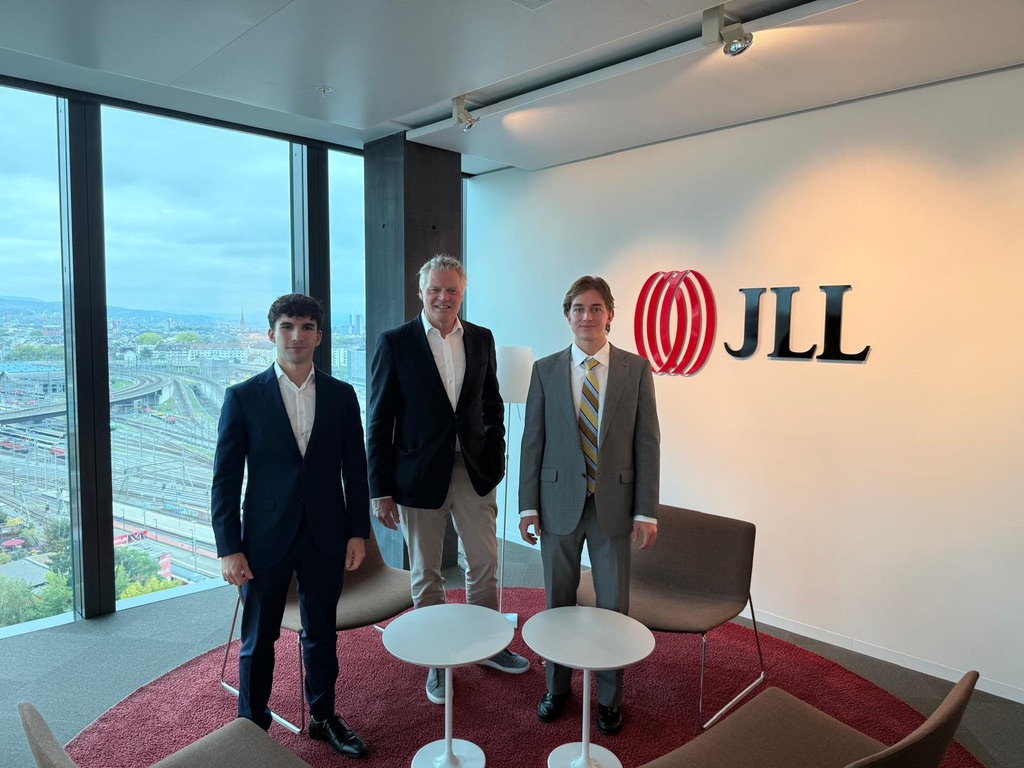
Interview conducted by Pedro Bento and Carlos Manuel Werth Palau.
Edited by Carlos Manuel Werth Palau
We sincerely thank Mr. Jan Eckert for the open and inspiring conversation about career, real estate and dealing with change and crises.

Finance Network Lucerne